THE LITURGY OF THE WORKBENCH
Craftsmanship, physical presence, and creaturely sanity. Why material resistance, trade competence, and embodied labor form an impenetrable line of defense against the disembodied managerial state.
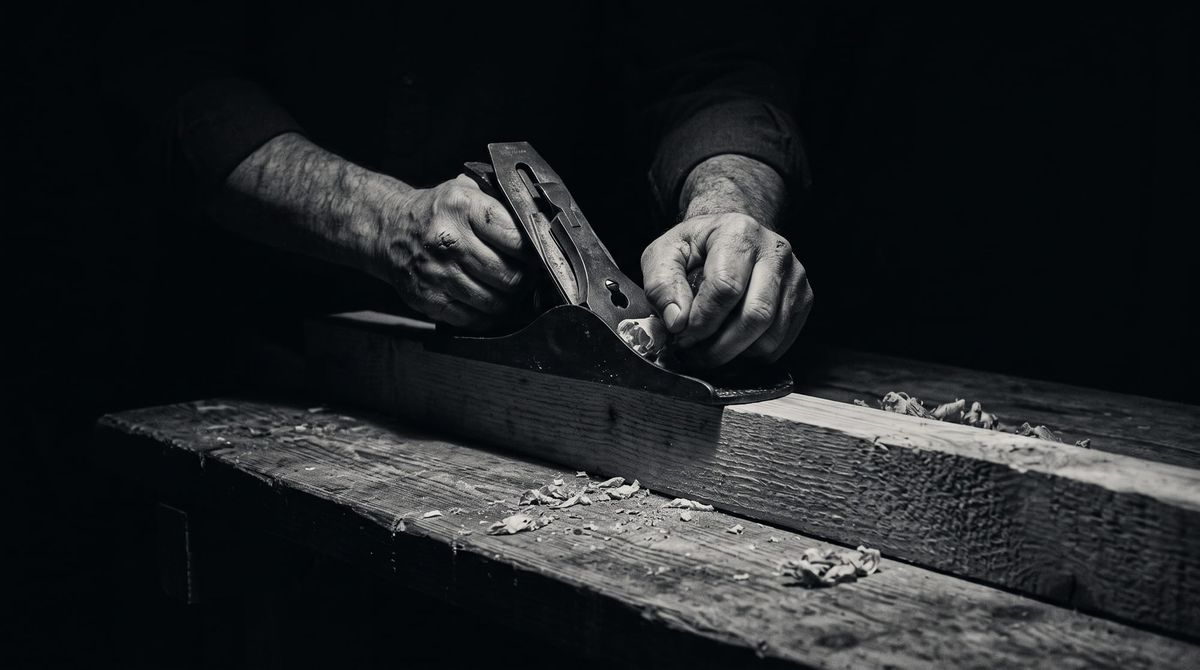
Craftsmanship, Physical Presence, and the Reclaiming of Creaturely Sanity
ACADEMIC PROLOGUE
THE EPISTEMOLOGY OF FRICTION AND EMBODIED VOCATION
The late managerial state derives its coercive leverage from universal abstraction. By detaching value from physical matter and transmuting production into financialized symbol manipulation, the technocracy produces an anxious, deracinated population wholly dependent on fragile, centralized digital rails. In this disembodied matrix, truth ceases to be tested against material limits and is instead subordinated to institutional perception, algorithmic consensus, and bureaucratic fiat.
Recovering the theology of manual craft is not an appeal to agrarian sentimentality or primitive nostalgia; it is an epistemological counter-insurgency and a thermodynamic imperative. Physical craftsmanship anchors human action to the stubborn, unyielding properties of the created order—the Nomos embedded in stone, iron, grain, and soil. To shape raw matter with one's own hands is to exit the managerial hall of mirrors, dismantle the gnostic illusion of virtual autonomy, eliminate fatal counter-party dependencies, and reclaim creaturely sanity under the authority of the Sovereign Architect.
We have constructed a civilization suspended thirty thousand feet above the soil, sustained by an invisible scaffolding of fiber-optic cables, speculative debt instruments, and algorithmic projections. In this disembodied economy, value is deliberately decoupled from physical friction. Temporal success belongs to the manipulator of symbols—the administrative technician who optimizes spreadsheets, calibrates automated workflows, and curates synthetic simulations without ever confronting the resistance of matter or bearing the physical weight of consequence.
Behind the glossy facade of the knowledge economy lies a silent, structural despair. The daily output of the cognitive laborer dissolves into the ether at the conclusion of every shift. A man expends forty hours navigating glowing glass, terminates his terminal on Friday evening, and looks down at empty palms.
Nothing has been shaped. Nothing has been planted. Nothing has been fortified. No physical monument exists to prove that an embodied soul inhabited that space in historical time.
This is not merely an economic dilemma; it is an ontological injury. By exiling human labor from the physical world, technocratic capitalism has evacuated the divine calling of its weight. Human beings were not engineered to operate as interchangeable, disembodied data processors servicing an administrative machine. We were formed from the dust of the ground, endowed with physical musculature, and commanded by the Sovereign Architect to govern, cultivate, and confront tangible reality.
THE TYRANNY OF THE FRICTIONLESS SCREEN
The supreme operational ambition of modern technology is the total elimination of friction. Every interface update promises a smoother transaction, faster throughput, and a synthetic environment where human desires are met instantaneously without the taxing mediation of physical toil.
In Shop Class as Soulcraft, philosopher and mechanic Matthew Crawford exposes the cognitive trap engineered into this frictionless ideal. When human work is restricted to symbol manipulation, reality ceases to provide an objective metric of truth:
- The Bureaucracy of Perception: In the modern corporate apparatus, success is adjudicated by narrative alignment, interpersonal diplomacy, and bureaucratic perception. Because the deliverable cannot be audited against gravity or structural failure, professional anxiety becomes permanent and chronic.
- The Humility of Material Intractability: Physical craft operates under an immutable metaphysics. A slab of quarter-sawn white oak does not negotiate with human sentiment. An engine block cannot be persuaded by institutional rhetoric. A weld either holds under tensile stress or the joint fractures.
- The Liberation of Objective Limits: In the workshop, the laborer is emancipated from the hall of mirrors that characterizes modern corporate politics. Matter imposes ruthless humility upon the mind. By submitting to the structural properties of wood, iron, or earth, the mind rediscovers objective reality and creaturely sanity.
When a society delegates physical competence to centralized automated systems, it surrenders the crucible through which human agency is tempered. The craftsman who works with his hands is anchored to the external world; the disembodied symbol manipulator is perpetually vulnerable to narrative engineering, economic blackmail, and existential dread.
THE SACERDOTAL HOE AND THE GARDEN ORDINANCE
Covenantal theology provides the only framework robust enough to defend manual toil against technocratic contempt.
In Genesis 2:15, Yahweh stations unfallen man within the Garden of Eden with a dual command: He placed him there to work it (lĕ‘obdāh) and to guard it (ûlĕšomrāh). These two Hebrew roots carry profound sacerdotal weight:
- Work as Liturgy (‘Abad): The root ‘bd is the identical technical term deployed throughout the Pentateuch to designate the priestly service of the Levites within the Tabernacle. Adam’s primordial garden labor was not a profane prelude to spiritual devotion; tilling the soil, pruning the timber, and directing the earth was an act of high priestly service offered directly to God.
- Guarding the Perimeter (Šamar): The root šmr defines the solemn duty to police the sacred boundary against profane intrusion. The physical cultivation of the earth is the precise mechanism by which the order of God is guarded, established, and expanded across the face of the globe.
The historical incarnation of Jesus Christ forever seals this creational dignity. Before Jesus proclaimed the kingdom of God or exposed the religious hypocrisies of the imperial age, He spent almost two decades laboring as a tektōn—a master artisan working stone, timber, and masonry in the dust of Nazareth.
The Son of God did not arrive as an abstract philosopher floating above the soil. He felled timber, struck iron wedges, hauled limestone, and bore the scars, callouses, and splinters of physical exertion. If physical trade labor were a sub-spiritual pursuit inferior to cognitive speculation, the Incarnate Word would never have chosen the workbench as His primary theater of adult preparation.
THE PAULINE IMPERATIVE MANUAL LABOR AS EXILIC IMMUNITY
The New Testament canon does not retreat from this creational mandate; it weaponizes it as a survival protocol against imperial hegemony.
When writing to the Thessalonian believers living under the shadow of the Roman empire, the Apostle Paul issues a severe command that confounds both the classical Greco-Roman contempt for physical manual work and modern welfare statism:
"Aspire to live quietly, and to mind your own affairs, and to work with your hands, as we instructed you, so that you may walk properly before outsiders and be dependent on no one."
— 1 Thessalonians 4:11–12
The Greek syntax reveals the structural strategy:
- Working with One's Own Hands (ergazesthai tais chersin hymōn): Greco-Roman paganism relegated manual craft (banausia) to slaves, reserving the life of contemplation for the elite aristocratic class. Paul upends this pagan hierarchy, commanding the covenantal community to embrace manual industry as an explicit mark of spiritual honor.
- Economic Autonomy (mēdenos chreian echēte): The purpose of physical labor is operational independence—to "have need of nothing" from the imperial state or its client-patron extortion networks. A man whose livelihood is wholly dependent on imperial favor cannot speak the truth without risking survival. The craftsman who commands an essential manual skill holds a sovereign buffer: he cannot be easily liquidated by administrative decree.
Paul modeled this anti-fragility personally. In Corinth and Ephesus, he labored as a skēnopoios (Acts 18:3)—a leatherworker and tentmaker—stitching rough canvas and tanning hides with his own calloused hands (Acts 20:34–35). He refused to allow his apostolic authority to be compromised by financial dependency on the local municipal elites. The workbench was his operational shield.
THE TITANIUM AXIOM
Physical competence is the material prerequisite for moral independence. The man who cannot repair his own tools, grow his own sustenance, or build his own roof is an indentured servant to whoever controls the grid.
THE MONASTIC PRECEDENT THE ARK OF ORA ET LABORA
When the Roman imperial matrix collapsed under administrative decay, monetary debasement, and barbarian incursions, classical civilization was not preserved by academic salons or imperial decree. It was preserved by the monasteries operating under the Rule of Saint Benedict.
Benedict understood that spiritual discipline severed from material labor produces moral and psychological ruin. His governing axiom—Ora et Labora (Pray and Work)—mandated that monks spend scheduled daily hours draining swamps, forging plows, breeding livestock, and binding manuscripts.
By wedding transcendent worship to the physical mastery of the soil and metallurgical craft, the monastic network constructed anti-fragile enclaves that weathered centuries of civilizational collapse. They were the arks that preserved technological competence, agricultural science, and literacy when every centralized Roman municipal system dissolved into dust.
In our late-stage technocratic cycle, the craftsman’s workshop functions once again as a Benedictine redoubt.
THE GUILD AS COUNTER SOVEREIGN LOGISTICS
To recover the sacredness of physical labor in an age of automated centralization, we must abandon aesthetic sentimentality and erect functional bastions of exilic competence:
- The Power to Repair Against Planned Obsolescence: The modern consumer is engineered for systemic dependency—crippled by remote corporate monopolies for every replacement component and proprietary software key. The man who can weld structural steel, rebuild an internal combustion engine, plumb a mechanical line, or solder a board maintains operational sovereignty.
- The Transmission of Generational Competence: When a father teaches his son how to grind a bevel, read grain structure, or rebuild an alternator, he conveys far more than mechanical dexterity. He confers an inheritance of patience, self-command, and unyielding respect for the created order.
- The Foundation of Sovereign Hospitality: Authentic hospitality requires material reality. One cannot shelter an exiled brother inside a spreadsheet, nor feed an afflicted family with a theoretical concept. Hospitality demands a roof framed with honest lumber, a table built from joined timber, and nutrient-dense bread cultivated from real soil.
RECLAIMING THE SOIL
The technocratic engine will accelerate its campaign to virtualize existence, automating cognitive redundancies and conditioning populations to accept physical detachment as progress.
Let the servers hum. Let the machine weave its fragile network of synthetic simulations.
For those bound to the Sovereign Architect, our commission remains fixed. We will honor the physical bodies fashioned from the clay. We will pick up our tools, labor under the sun, and demand that our sweat leave an indelible mark upon the physical earth.
Every square cut made with a hand saw, every seed planted in living ground, and every structural joint forged with precision is an act of defiance against the digital empire. In the weight of our hands and the sweat of our brows, we confess that matter matters, that physical craft is holy, and that our God is the Maker of heaven and earth.